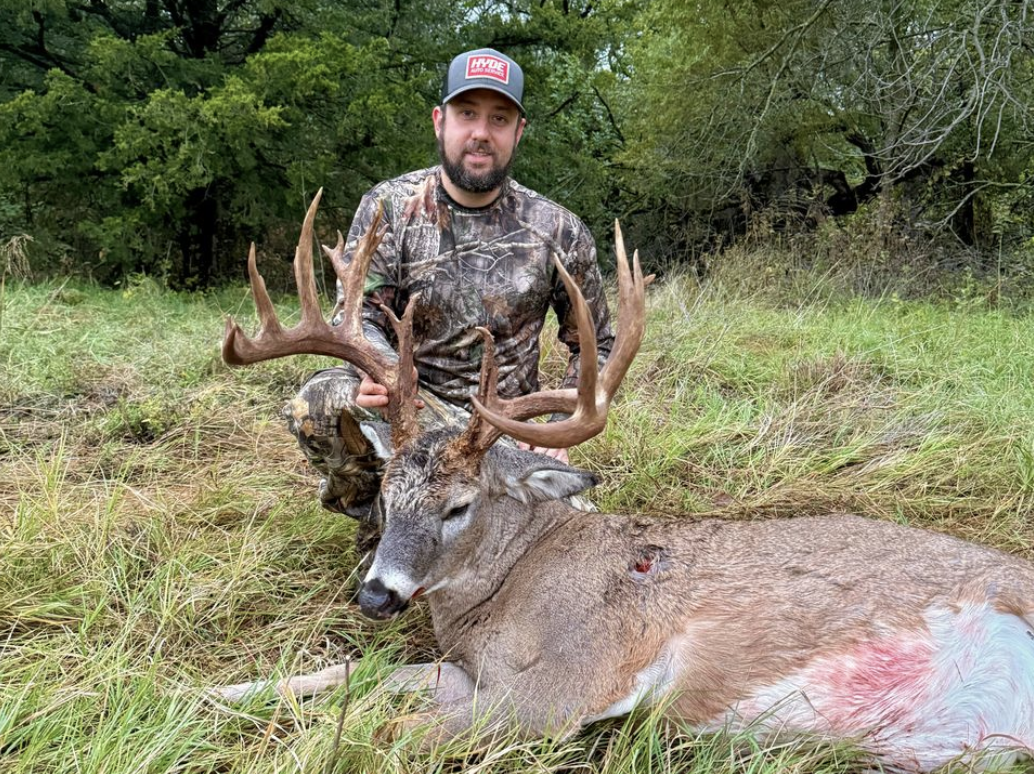
When Oklahoma’s 2025 archery season opened, Josh Mayo positioned his ground blind with a clear view across a hayfield popular with deer. But the wind shifted to the southeast, one evening, and Josh got busted when a mature buck snorted at him from 20 yards away. It turned out that the deer was a smaller, fellow traveler to Josh’s dream buck. Josh moved his blind 40 yards further south to a higher elevation with his back to a creek.
“I wanted to be in a steep enough area where the deer wouldn’t casually walk or cross the creek,” he says. “Deer don’t want to make the uphill effort, if they don’t have to. They are lazy creatures.”
(Readers who disagree are invited to let us hear from you.)
Josh was hunting a 30-acre property belonging to a friend in Oklahoma County in late October because a 19-point, 209-inch buck was showing up on his trail cam.
“The first and only time I saw him in the flesh was the day I shot him,” Josh says. “Before that, as far back as early 2024, I was seeing gray images on my phone. At first, I had no information about the property. I had to scout to see if it was worth my time. Then the camera showed me this beautiful deer, still in velvet. I hunted it pretty hard, that first year, but never had a shot opportunity.”
So in 2025, Josh made a plan to get in his ground blind before sunup. On archery opening morning, he headed out at 3 a.m. He parked by his buddy’s house and walked 500 yards through the hayfield. He heard deer moving in the dark. But they heard him, too. “It was risky; I probably shouldn’t have gone in that early. I had to lie down in the damp grass for 90 minutes until I thought the deer had moved away. Then I got in my truck and went home.”
Although small, the property offers deer a creek, bedding (and food) from a field of Johnson Grass, acorns, and cover from a 2-acre patch of woods. It’s about an hour and a half away from Josh’s home, so when the weather is favorable, he can get to his blind pretty quickly. The 31-year old auto repair expert is his own boss. “I’m pretty generous with giving myself time off to hunt,” he says.
Whereas cell phone notification from trail cams is fast becoming the basis for locating bucks, Josh mainly still uses “old-school” skills.
“Patterning and observing a mature buck requires looking for rubs and natural highways — places where the vegetation is beaten down,” he says. “I look for water sources and food where bucks congregate. I do also rely on one camera I hung on a tree at the edge of the woods facing the field.”
On Oct. 25, Josh’s wife and daughter were going out of town to central Texas for a week. He planned on hanging around with them all day, but at 3 p.m. he noticed that the wind had switched northeast to nearly straight south. “I would have the wind in my face while my buck could come in front of me. I said, I hate to leave you guys, but conditions seem to be perfect. Because of unfavorable wind, I had only been able to sit and hunt that buck six times out of 25 days. I wanted to give it a shot.”
He arrived at his blind around 4:45, later than he likes to start at that time of year. Once settled in, Josh got distracted by the University of Texas vs. Mississippi State football game on his phone.
“The game had become interesting,” Josh says. “Right as Texas was about to score, I looked up and my buck was standing 45 yards away at my 10 o’clock. My bow was in my lap with an arrow nocked, luckily. But then I started shaking. I sat there looking away from the deer on the theory that, if you’re not looking in their eyes, they’re not as likely to run. It’s something I heard.”
Josh thought the deer would haul out of there, but it put its head down and started grazing. It stepped a few yards, then ate. Josh used the head lowering action to adjust his direction in his chair and make sure his shot would clear the window ledge.
“I still wasn’t looking into the buck’s face while I tried to calm my heart rate, with no success. He was 27 yards from me and picked up a leg to walk forward; when he placed that foot down, I shot behind his right shoulder. He lunged immediately. I thought he would get away but heard him pile up right at the tree line 40 yards from the shot location It was a double lung shot and he died immediately.”
The time was 5:30 p.m. Josh sat for 15 minutes before exiting the blind. Examining the buck’s last position, he saw a fair amount of bubbly dark blood. Ten yards further, Josh saw white belly hair and saw the rack for the first time.
“I kept saying, I can’t believe it, I can’t believe it. The amount of mass was insane. I called my wife Emily, then a friend from the navy. We served in Norfolk VA on the USS Abraham Lincoln. I called the landowner and showed him a picture. It’s really cool to think that my wife and daughter hadn’t left town and could share that moment with me. They arrived and watched me drag the buck from about 100 yards from tree line to my truck.”
Josh shot his first buck, a small basket rack, when he was 14. If he could talk to his 14-year-old self about hunting, he would say, “Be patient, use the knowledge you have, and shoot as often as you can.”
.png)