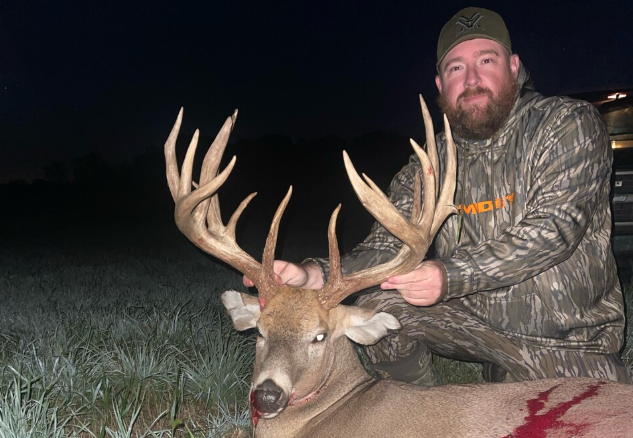
Cameron Masters first became aware of the buck he shot in 2025 two years earlier, when it was a 4-year-old, thick-antlered 7-pointer that might have scored 140 inches. The following year, he saw the deer — bigger that time — locked down with a doe a mile and a half from his property in Franklin County, Indiana.
“He still looked like a big 7-pointer then, nothing like what he became the next year,” he said.
The first trail camera photographs of the no longer slow-growing 7-pointer came in late July 2025. The hunter from Laurel was running five cameras on the property, and the deer managed to trip two units’ triggers.
“When I finally got a decent picture of it, I could see that it had put on between 50 and 60 inches of antler in one season,” he said. “This one had me stumped when I saw it again in 2025. It took me about three weeks to connect the dots.
“It looked like it had a pair of scissors inside. That’s when I knew,” he added.
Images were sparse at first, but most of the 100 he collected were from a third camera he’d set out on a post after seeing big tracks at a fence crossing. He has access to an enormous alfalfa field behind two planted in corn, in which the deer was bedding.
With two businesses — a trucking company and a dry ice and laser cleaning outfit — to run, Cameron doesn’t have much time to hunt, one reason he hunts only the “red moon.” He bought into what he calls the “life-changing” theory about nine years earlier.
“If you’ve got a big mature deer, hunting the red moon is absolutely lethal. The older the deer, the better. It’s worked crazy well for me.
“I basically leave (deer) alone and let them do their thing until then,” he says. “A lot of people wait and hang their hopes on the rut, but I have no use for that.”
Leaving deer alone doesn’t mean he doesn’t try to keep tabs on them. He’s just as serious about knowing where to hunt as he is about when to go, and that requires surveillance.
“I even bought a cheap truck, so people wouldn’t know it was me paying attention to a particular spot,” he said. “I’d park at one end of the cornfield, where there was sort of a hole, and walk the fenceline to the 80-acre alfalfa field to see where all the deer entered it.”
After a second camera began yielding photos, he placed another on a stick near the weedy strip, hoping to pin down the buck’s entry point. The place was littered with large tracks in the mud and torn-up cornstalks.
Before he set out the lollipop camera, all he knew was the deer would be in the alfalfa at night, and then go back into the corn. He thought it was continuing east, but it was turning west within the maze of stalks.
“It had to be that buck,” said the 39-year-old father of two (about to be three).
Three hours after the new camera was in place, he got daylight photos of the buck, confirming his hunch that it had come out of the corn there.
“He was coming out there almost every time. I knew what he was doing, where he wanted to be. The problem was, he was coming out every day after dark, which at least told me where I needed to be.
The season’s first red moon occurred on Oct. 10, but Cameron couldn’t take advantage. He had a wedding to attend on the 11th. He went on Oct. 12, following the phase’s second night. It was 70 degrees that day, and there was a northeast wind, which was perfect for the destination he had in mind.
There were no climbable trees where the trail camera indicated the buck was crossing the fence en route to the alfalfa — including 30 minutes before daylight that morning — so he planned to hunt from the ground. He asked his wife to drive him in.
He got out, backed up to a fencepost within a strip of 6- to 8-feet-tall weeds missed by the bushhog around 4 p.m. He was maybe 45 yards from the camera that had yielded so many photos.
“It’s useless to hunt that place in the mornings because there are too many deer in the field,” he said. “There’s no way to get in there without spooking them.
“In fact, the person who hunted it before I got permission claimed it was unhuntable,” he said.
Because it is so open there, almost all cover vanishes after the crops are harvested.
Cameron heard something moving in the corn, as if a deer had stood, and then he heard antlers possibly raking one of the small trees in the fenceline. After 20 minutes of silence, he heard the telltale thud of a deer jumping the fence.
Five minutes later, his phone buzzed in his pocket. It was a photo of the buck.
“That’s when my heart started pounding,” he said.
He drew when he heard the deer start walking.
He shot when it got to within 15 yards with only 8 minutes of legal daylight remaining.
“It’s kind of funny. I’d told my dad I was going to shoot a good deer from the ground with my bow,” he said.
“That’s my one-and-done story,” he laughs.
The red moon in deer hunting isn’t about the moon’s color. It refers to specific days each month when its gravitational pull peaks, creating “overhead” (Northern Hemisphere) or “underfoot”(Southern Hemisphere) periods that coincide with sunrise/sunset, believed to trigger increased deer movement, especially mature bucks, during daylight hours for better hunting opportunities.
While some hunters swear by it as prime time, scientific evidence is mixed, suggesting it works best alongside other favorable conditions like cold fronts and barometric pressure changes.
Scott Beam measured the 15-pointer for Buckmasters, arriving at 206 7/8 inches.

.png)