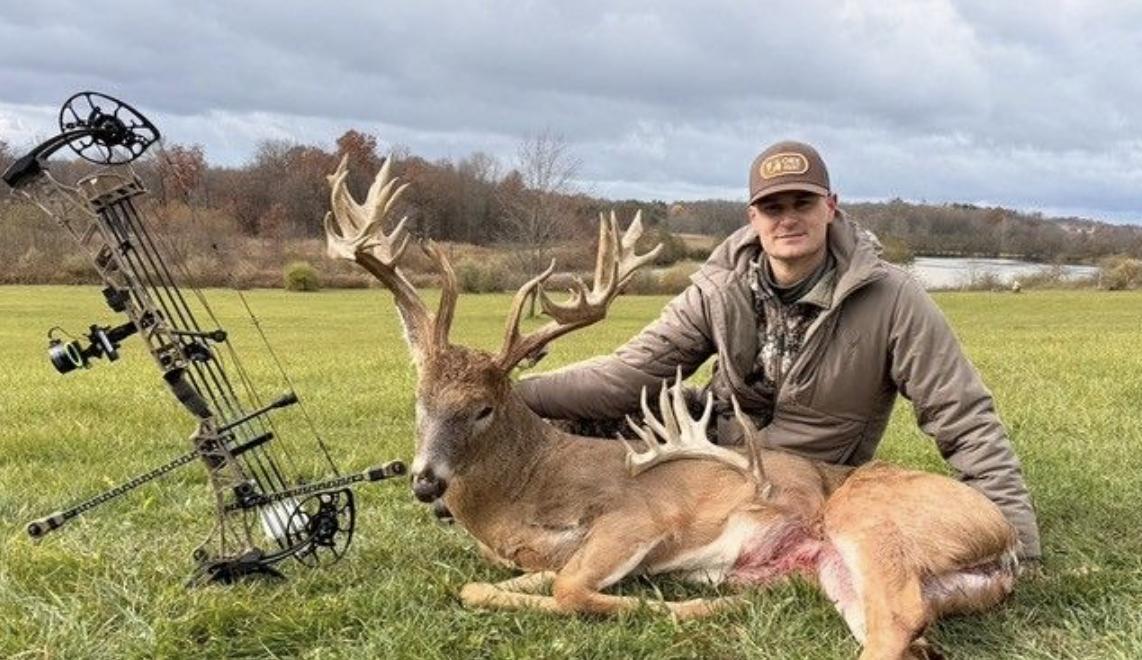
Three years of patience and patterning a 23-point buck paid off for Laine Baker, although he could have done without the drama in act three.
The 34-year old police officer started his love-hate affair with a promising buck in 2023, in Lawrence County, PA. Laine decided he’d wait another year but kept painstaking, detailed notes on its behavior. He had permission to hunt on 180 private acres that offered deer both woodsy cover and soybeans; this turned out to be his buck’s home turf.
“I guessed the deer to be around three years old, but it was confirmed after the hunt, when I sent his teeth to Deer Age, a wildlife analytical lab in Missoula, MT. According to their examination, my buck was five and a half in 2025 when he was shot. So he was three and a half, the first year.”
From 2023 through 2024, Laine recorded data such as the whitetail’s times to move, preferred bedding spots and favorite routes to and from food.
“In 2024 he grew into a nontypical giant,” Laine says. “In velvet season, he had grown into a freak with maybe 18-20 points everywhere. But I still chose not to hunt him.”
Using trail cams and a spotting scope on summer evenings, he says, “I thought he probably measured in the 170-inch class.”
By knowing the buck’s whereabouts, Laine located both sheds from 2023 and the right side from 2024.
In the summer of 2025, Laine relocated the homeboy buck that didn’t roam. He watched as brow tines sprouted and curled out. Once its velvet was shed, he knew that was the deer he’d target.
“I didn’t pressure him. I watched from a distance and reviewed my trail cams. Turned out, his preferred bedding was in standing corn. When the farmer harvested some corn, my buck moved over to the next field of corn.”
During the pre-rut, Laine started hunting more. Around Halloween, he put in all-day sits. Things heated up during the first week in November: Laine had five close encounters in succession.
“All were within 300 yards. I had my bow with me but didn’t have an ethical shot. He was either too far away or chasing a doe. On the fifth encounter, he was downwind of me and moved off pretty quick.”
On Nov. 9, a drenching rain stopped around noon. Laine believes that downpour was a real boon to his hunt.
“I called my boss, told him I was taking the day off and drove to my hunting spot. I had to walk down the road to access the particular stand that was appropriate for the northwest wind, then I walked 150 yards up a dry creek bed, to keep my scent down. I noticed movement straight ahead of me: Lo and behold, my buck was bedded in hard woods. A doe was walking around him; that was the movement. She was in estrus, and he was focused on her.”
At that point, Laine decided to ground hunt and forego his stand. He put his release on his wrist, nocked an arrow and ranged the buck: 67 yards.
“The forest floor was soft and quiet from the rain. I never would have gotten close enough if the rain hadn’t soaked the crisp autumn leaves. I peeked up over the 6-foot high bank, and I spooked the doe — she was 20 feet away.”
The doe booked it, and Laine watched her take off and cross a bean field 300 yards distant. He thought the whole hunt was over. But the tricky part was yet to come.
“I caught movement to my right,” Laine says. “The buck made a big clockwise circle and bedded down again behind a thick oak. I would have to put up a serious creep to get in bow range. At that point, I lay down on the November-cold, wet ground for 10 minutes to let him calm down. The bow was in my left hand. As I belly crawled, I scooted it in front of me, then put it down, crawled another few yards and set it down. This went on for over an hour!”
Laine crawled until all of the deer was concealed except for one antler. He only stopped when he ranged the oak tree at 35 yards.
“I knew that was my opportunity,” he says. “I slowly stood and connected my release to my D-loop and got ready to draw. I crept to the right side of the tree until a shot at the buck’s vitals was possible. A stand of thorny multiflora rose bushes were so thick I could just make out his outline. The thorns formed an impassable barrier.
He knew he couldn’t go any further, so he just stood very, very still.
Maybe the grueling approach would pay off. But the buck had to stand for Laine to target its vital area. He thought about making a doe bleat, but didn’t want the deer to jump and start away.
“I just stood glued to one spot for well over an hour until, finally, at 4:45 p.m., he slowly rose up on front legs and stood. He looked in my direction,” says Laine. “At that instant, when he was completely broadside, I went up on tiptoes to shoot over the bushes. My arrow sunk into his upper rib cage.”
Fairly sure he’d made a solid hit and with sundown approaching, Laine went back to his truck and called three friends. Two hours later, with cordless spotlights, they went back down the creek to the shot location. They found Laine’s arrow five feet away.
“We followed the blood trail for 150 yards to a cut bean field,” he says. “We followed him another 100 yards by his tracks, and then the blood resumed. We got to the wood line and the same trail he’d used all summer long. He was lying 20 yards inside the woods.”
Laine is not ashamed to say he shed some tears of gratitude for the trophy of his life, so far.
“I lost it. It had been a three-year journey and felt bittersweet to put my hands on him.”
.png)