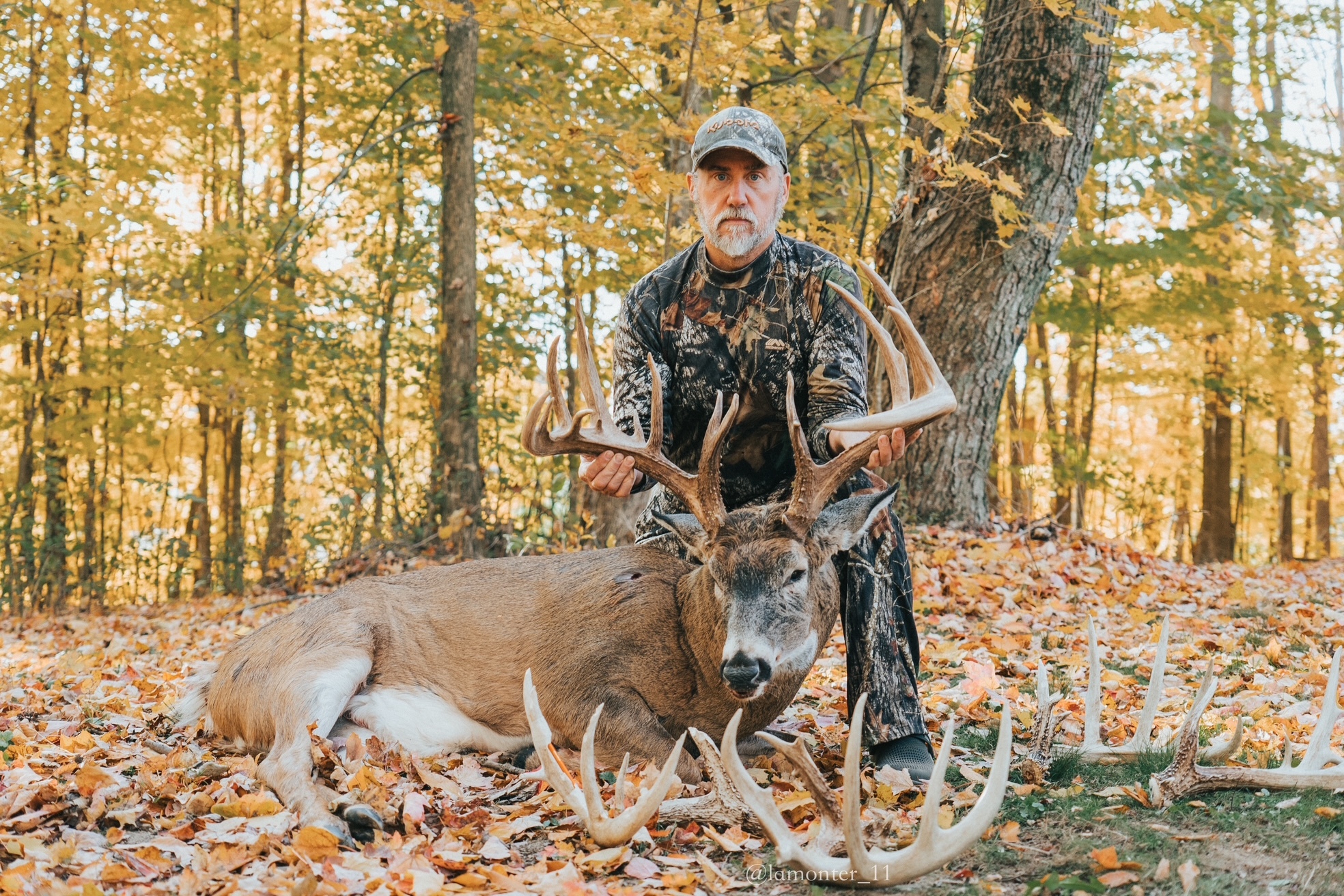
Terry Monter knows a thing or two about deer, even though he hasn’t fully embraced today’s technological advancements responsible for keeping taxidermy businesses afloat.
The hunter from Minerva, Ohio, is just as curious as the next guy or gal, which is why he owns the simplest and most inexpensive trail cameras. He puts them to work just before the season opens, and he might check them once a month until he fills a tag.
Mostly, he just tries to think like a deer.
Terry thought his freezer-filling days were over when his father sold the 46-acre honey hole he’d cherished for years. Unexpectedly, however, another door opened when a friend offered to let him hunt the 100 acres he’d just bought.
The first year he hunted the new place, he ate his buck tag.
“I’m not real picky,” says the 59-year-old retired police officer. “I’m just after a decent 8- or 10-pointer. Plus, two back surgeries limit my time in treestands.”
The deer he shot in 2024 had been seen multiple times by the neighbors, among them a buddy of his 26-year-old son Logan. The friend had found one of the buck’s sheds about 200 yards from where Terry hunted, and he’d often share photos of the whitetail, asking the Monters if they’d seen it on their side of the gravel road.
The neighbor also shared a video of the deer taken right after he’d shot another buck in 2023. It was even bigger then, and it wore a drop tine.
Terry considers himself an old-time hunter, meaning his trail cameras aren’t cellular. He rarely uses them at all, relying only on the reconnaissance to tell him what sort of bucks are passing through a property once the season opens.
He checks them about once per month.
“I see the benefit of cell cameras. They’re why folks are killing bigger deer nowadays. But I’m not a guy to say ‘This is my target buck,’” he adds.
He usually starts hunting around Oct. 17 or 18, never before the 15th, which is his anniversary. In 2024, his first trip out was on the 20th, to another 11-acre parcel in Harrison County.
The next day, he set up a camera and two stands on his friend’s Carroll County tract, both near thick spots closest to where the deer’s 2023 shed was found. One of the setups was a lightweight hanger above climbing sticks, 20 feet off the ground. It overlooked a creek crossing within a thicket.
“After leaving their beds in the CRP and crossing the road, it’s a good place for deer to settle down and feel comfortable,” he said. “It’s real wet in there, and the land is uneven.”
Terry’s first visit to the hang-on stand overlooking the staging area was Oct. 24.
“I didn’t realize how close I was to an oil well, which was really noisy — so loud that I never heard an 8-pointer arrive,” he said. “But seeing that deer revealed that two small trees were obscuring my shooting lane.”
Terry got down and cut them, and then went home to eat lunch and change clothes. He was back in the stand by 3 p.m.
Close to 6:00, Terry happened to look up and see another 8-pointer and a doe approaching. Behind them was a shooter buck, the biggest he’d ever seen on the hoof.
Figuring the deer bringing up the rear would keep to the same path the others had taken, Terry grabbed his crossbow and waited for it to reach an opening. As soon as it did, he grunted, the deer stopped, and he squeezed the trigger.
After waiting 20 minutes, he went home to call his son and the neighbor. Two hours later, the three of them returned to recover the animal, which had traveled only 80 yards.
The neighbor recognized it immediately, and he called his dad, who was also hunting it.
Ed Waite measured the antlers for Buckmasters, arriving at 211 2/8 inches. The 21-pointer is a mainframe 5x5 that stretches 23 inches between the beams. There’s enough abnormal growth, however, to land it in the irregular category.

.png)